
After completing ten physiotherapy sessions for my lower back and sciatica, I reached the second half of my treatment programme: ten sessions focused on my knees.
My back had been the urgent problem that brought me to physiotherapy, but my knee problems were not new. An MRI taken several years earlier had shown meniscus degeneration and fluid, and I had lived with stiffness and pain for a long time.
I had also learned to work around the problem without always realising it. I used my hands to help myself stand, relied on momentum and did my best to avoid the stairs at home whenever I could.
The next ten sessions showed me that working on my knees was not only about the knee joints themselves. My quadriceps, hips, balance and the way I controlled my legs all affected how I moved. Some exercises looked simple, but they revealed weaknesses I had been compensating for in everyday life.
My Physiotherapy Journey Series
This is the final part of my journey. Start with [Part 1: How My Physiotherapy Journey Began] or read [Part 2:My First Ten Back-Focused Sessions].
Moving From My Back to My Knees
Shifting the focus to my knees did not mean that we completely forgot about my back. Many of the exercises still involved my hips, thighs and core because these parts of the body do not work separately.
We usually started with the treadmill. Depending on the session, I walked for around eight to thirteen minutes, sometimes reaching approximately 4 km/h with an incline. Later, I also walked while wearing ankle weights.
During one of those sessions, my pulse reached 170. The walking may not have looked particularly intense from the outside, but my body was clearly working much harder than it appeared. The added weight and incline made an ordinary treadmill walk far more demanding for me.
At the centre, I started with 2.5-pound ankle weights on each leg. Exercises that had become familiar during the back phase suddenly felt very different with the added weight.
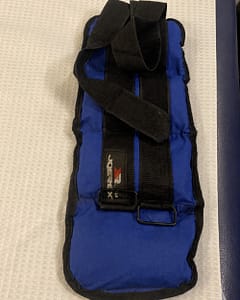
I performed straight-leg raises while lying on my back, side and stomach, along with heel slides and knee bends. We also worked on seated knee extensions, bridges and lifting my knee towards Mona’s hand as a target.
With a resistance band, I moved forward, sideways and backwards rather than strengthening my legs in only one direction. Mona also held my leg while I pushed or kicked against her resistance, forcing me to use control instead of simply swinging my leg.
Many exercises were completed for 20 repetitions. One movement on its own might not have looked difficult, but the repetitions, weights and different positions quickly added up.
By the end of the programme, Mona told me that I could eventually use ankle weights of around 4.5 pounds, or approximately 2 kilograms, at home when I was ready. She did not encourage me to rush. Correct form, controlled movement and avoiding overexertion remained more important than making every exercise as difficult as possible.
The Low Step Revealed My Weakness
One of the clearest moments of the knee phase came from a very ordinary movement: standing up.
Mona asked me to sit on a low step and stand without using my hands. I tried, but I could not do it.
That simple attempt revealed the weakness in my legs more clearly than a long list of exercises could. In everyday life, I could push myself up with my hands, lean forward, use momentum or choose a higher seat. On the low step, those usual ways of helping myself were removed.
It made me realise that I had probably been compensating for weak muscles without noticing it. Strengthening my thighs was not only about completing sets in the centre. It was connected to something as basic as getting up from a low seat without depending on my hands.
Working on My Kneecap Movement
Patellar mobilisation also became part of my treatment. Mona gently moved my kneecaps in different directions to check how well they glided.
The first time she assessed the movement, she said the kneecap was not gliding as much as she would have preferred. Moving my left kneecap downward was also painful.
My right kneecap naturally sits higher than the left. That is part of my anatomy rather than something physiotherapy was expected to change.
After working on the kneecap movement over the sessions, Mona checked it again and was pleased by how much better it glided. She said it was “almost dancing now!”
That comment stayed with me because it turned a subtle improvement into something I could picture. It did not mean that every problem in my knees had disappeared, but the movement had clearly improved enough for Mona to notice the difference.
My Balance Problem Was Still There
During the back phase of my physiotherapy, we had already discovered that my balance needed work.
When I tried to stand on one leg for 15 seconds, my right side was noticeably weaker. At another point, I nearly lost my balance while trying to raise the same arm and leg, leaving me confused enough to ask Mona, “What just happened?”
The balance work continued during my knee sessions. Standing on one leg requires the foot, ankle, knee, hip and core to keep making small corrections, so balance could not be separated from knee and leg strength.
This was particularly interesting to me because I also have flat feet. I cannot say that every balance difficulty I experience is caused by my feet, but physiotherapy helped me understand how weaknesses in different parts of the body can affect one another.
From Dreading the Stairs to Using Them Without Fear
The stair work became one of the most meaningful parts of the knee phase because it took me back to my very first day at the centre.
After my initial assessment with Dr.Hussain, I was waiting to meet Mona. It was prayer time, and one of the receptionists kindly took me upstairs so we could pray together.
The moment I realised that I would have to climb the stairs, I was saying “Nooooo” in my head.
Going up was painful that day, and coming back down was painful too. It was not only a problem at the centre. At home, I also did my best to avoid the stairs because I had come to associate them with knee pain.
During my fifth knee session—Session 15 of the full programme—Mona asked me to use the stairs again. This time, she told me to be mindful of how I placed each step.
What relieved me was not only that I could go up and down without pain. The fear I had felt on my first day was no longer there.
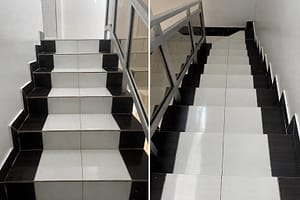
That was one of the clearest signs that the exercises were carrying over into everyday life. The treadmill, squats, balance practice and repeated leg movements were no longer isolated tasks inside the treatment room. They had helped me return to something I had previously dreaded and approach it differently.
Ultrasound, Mobilisation and Electrical Stimulation
After the active exercises, my sessions also included therapeutic ultrasound, patellar mobilisation and electrical muscle stimulation, or EMS.
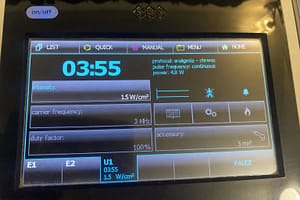
The placement of the EMS pads changed as the sessions progressed. Earlier, they were positioned around my knees. Later, Mona placed them above my knees and higher on my thighs to work the quadriceps more directly.
The contraction patterns and intensity changed too. I could see and feel my thigh muscles tightening, and the later sessions became much more demanding.
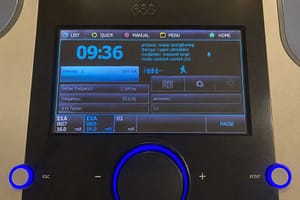
Session 19 was the most exhausting of my knee sessions. My thighs were extremely sore afterward. I had already completed repeated exercises with ankle weights, and the stronger contractions from the EMS added another level of effort.
It certainly did not feel as though I had simply been lying there while a machine did all the work. My muscles had been contracting repeatedly, and my thighs made sure I knew it afterward.
Reaching My Twentieth Session
By my final session, many movements that had once felt unfamiliar had become part of a routine.
I warmed up on the treadmill and continued with weighted leg raises in different positions, heel slides, controlled leg-lowering movements and resistance-band squats. The exercise portion was followed by ultrasound, patellar mobilisation and EMS.
Finishing that session meant more than reaching the end of another workout. I had completed all 20 physiotherapy sessions: ten focused on my lower back and ten focused on my knees.
I had fitted the sessions around my work schedule, sometimes going directly from physiotherapy to work. I had continued through the tiring exercises, soreness and moments when my body did not respond as I expected.
However, completing Session 20 did not mean that the work was finished.
Mona gave me a home exercise programme and reminded me to begin with the light resistance band rather than immediately moving to the medium or hard bands I already owned. Form and alignment still mattered, and she warned me not to overdo it.
She also showed me how to use kinesiology tape for my bunions and practise an exercise with a toe separator. Most importantly, she told me that I could text or call her if I had questions. Because of my changing work shifts, returning immediately would be difficult, but I could potentially go back to the centre after approximately two months.
Mona was not the only person who made the experience easier. Deka, Harbi and the rest of the reception team were always kind and helpful throughout my time at the centre. That warmth mattered, especially when I was attending so many sessions over several weeks.
What Changed After Ten Knee Sessions?
Ten sessions could not erase my meniscus degeneration, flat feet or bunions, and I did not expect them to.
What changed was how I moved and what I understood about my body.
I could use the stairs without the pain and fear I had experienced on my first day. My kneecap glided better during mobilisation. I became more aware of the weakness in my quadriceps, hips and right-side balance. I also learned how to continue strengthening these areas at home instead of treating the end of physiotherapy as the end of movement.
Sometimes progress is a movement becoming less painful. Sometimes it is discovering a weakness that you had unknowingly worked around for years. Sometimes it is your physiotherapist smiling because your kneecap is “almost dancing.” And sometimes it is reaching the stairs and realising that the fear has already disappeared.
My supervised physiotherapy sessions are finished for now, but maintaining the progress is my responsibility. My knees do not need one perfect burst of exercise followed by another long period of inactivity. They need steady, controlled work that becomes part of my ordinary life.
That may be the most important lesson I took from these final ten sessions: stronger knees are not only about what happens inside the knee joint. They affect how I stand, balance, climb stairs, sit down, get back up and trust my body during everyday movement.
The 20 sessions gave me a starting point. What I do with that starting point comes next.
This post describes my personal physiotherapy experience. It is not medical advice, and the exercises and treatments that were suitable for me may not be appropriate for everyone. A qualified healthcare professional can assess your individual symptoms and needs.