
In the first part of my physiotherapy journey, I shared how a fall in Arta eventually led to an MRI, a diagnosis of an L5–S1 disc protrusion, and a referral for 20 physiotherapy sessions.
The first ten sessions would focus on my lower back. After that, we would move on to strengthening my knees and working on the meniscus problems I had lived with for years.
I already knew that my back hurt, but these sessions revealed that pain was only part of the problem. My back and core muscles were weak, my hamstrings were extremely tight, and my balance and coordination were not as good as I thought.
This was when the real work of rebuilding my back began.

My Physiotherapy Journey Series
This is Part 2 of my journey. Read [Part 1: How My Physiotherapy Journey Began], then continue to [Part 3: Ten Sessions Focused on My Knees].
Meeting Mona and Starting Treatment
Mona was the physiotherapist who guided me through my sessions.
At first, many of the exercises looked simple. I had to lie on my stomach and lift my upper body, raise my legs, activate my core, stretch my hamstrings, and later perform exercises such as bridges.
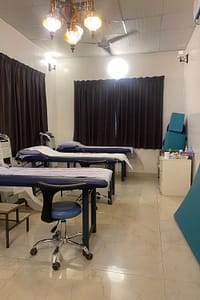
I did have one advantage when I started: I already had some experience with yoga. Because of that, I understood the importance of posture, controlled movement, and paying attention to how my body was positioned. I could usually understand Mona’s instructions and pick up the exercises fairly quickly.
But if I had a background in yoga, how had my body become so weak and stiff?
The honest answer is that I had never been consistent with it. I practised yoga on and off, but I often struggled to keep showing up on the mat regularly. I think many people have the same problem: knowing that movement is good for us does not necessarily mean we do it often enough.
Little by little, as the gaps between my yoga sessions grew longer, my body became stiffer. My yoga experience helped me understand the physiotherapy exercises, but occasional practice had not been enough to maintain my flexibility or build the strength my back and core needed.
Physiotherapy made the difference between knowing how to move and actually moving consistently very clear to me.
Even with my yoga background, simple did not mean easy.
Because my muscles were weak, holding some positions for even a few seconds required real effort. We started with shorter holds—around 10 seconds—and gradually increased them to 15, 20, 25, and eventually 30 seconds.
The number of repetitions increased too. Mona adjusted the exercises gradually as I became better able to control the movements and maintain the positions.
This taught me that improvement does not always arrive as one dramatic change. Sometimes, it is simply realizing that you can now hold an exercise for 30 seconds when 10 seconds once felt difficult.
My Extremely Tight Hamstrings
Stretching was a major part of every session, and it was where I truly discovered how tight my hamstrings were.
And tight hamstrings are no joke. They are painful.
One exercise I did during every session was the forward stretch. I sat with both legs extended in front of me and reached forward as far as I could. During the earlier sessions, the pulling along the backs of my legs was intense.
But the forward stretch was not the only exercise that challenged my hamstrings.
For another stretch, I lay on my back with both legs straight. Mona held one leg firmly against the treatment table while helping me raise the other leg upward and keep it straight. She then repeated the stretch on the other side.
This was probably the stretch that showed the tightness in my hamstrings most clearly.
As Mona raised one leg, she had to keep the other one pressed down because my body naturally wanted to compensate for how limited the movement was. I could feel the stretch strongly through the back of my thigh.
It hurt, but it also showed me exactly how much flexibility I had lost.
By around my sixth session, my forward stretch had noticeably improved. While I was holding the position, Mona placed her phone in front of me so I could see myself live as I stretched.
My fingers had reached past my feet.
She was not showing me two photographs side by side. I could see myself on the phone at that exact moment and see how much farther I could now reach compared with the beginning.
When you repeat the same exercises during every session, it can be difficult to notice the small changes in your own body. Seeing my fingers pass my feet made the improvement visible. All those painful stretches were actually achieving something.
The Bird-Dog Exercise That Almost Sent Me Over
One of the most memorable—and confusing—moments happened during a balance and coordination exercise performed on my hands and knees.
It began like a bird-dog exercise. While staying on all fours, I had to lift one arm and one leg while keeping the rest of my body steady.
Raising the opposite arm and leg—the usual bird-dog movement—was manageable. But Mona also asked me to try lifting the arm and leg on the same side.
As soon as I did, I lost my balance and almost tipped over. Mona had to steady me.
I looked at her, completely confused, and asked:
“What just happened?”
That was when she laughed and said:
“Aha, we found something else to work on.”
The movement had looked so simple that I did not expect my body to react that way. But as soon as I raised my arm and leg on the same side, I could not keep myself properly balanced.
It was funny because I genuinely did not understand what had just happened. At the same time, it revealed another weakness that I had never noticed during ordinary daily life.
Until then, I thought of balance mostly as the ability to stand without falling. That exercise made me realize how much it also depends on coordination and having enough core strength to keep the body stable during movement.
It was particularly surprising because my yoga experience had made me familiar with balancing poses and controlled movements. Yet this one exercise still exposed something that I needed to work on.
The Treatments After the Exercises
The exercises were only one part of my sessions. Afterward, Mona used different treatments depending on how my back felt that day.
These included:
- Infrared heat
- Therapeutic ultrasound
- Electrical stimulation
- Vacuum electrotherapy
- Manual work on the painful areas
- A massage gun
The infrared light warmed the area being treated, while therapeutic ultrasound was applied to my lower back. The electrical treatments produced different sensations depending on the machine being used.
Vacuum electrotherapy involved suction cups combined with an electrical prickling sensation. It felt unusual in the beginning, but eventually it became another familiar part of my sessions.
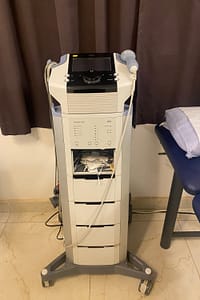
The hardest treatment for me was the manual work.
Those Painful Points in My Back
Mona found several extremely tender points in my lower back and the surrounding muscles.
When she pressed directly on them, the pain could be intense. My body would automatically tense up, and Mona repeatedly reminded me to breathe deeply.
That was easier said than done.
When someone presses directly into an already painful area, tensing up feels like the body’s natural response. I had to make a conscious effort to breathe instead of holding my breath and fighting against the pressure.
Sometimes Mona used her hands, and sometimes she followed the manual work with the massage gun.
The treated areas could feel sore afterward, almost as though they had been bruised. On at least one occasion, I did end up with a visible bruise.
I am not going to pretend that this part of physiotherapy was pleasant. It hurt.
However, as the sessions continued, Mona told me that the painful points were still there but were becoming fewer and less painful than before. They had not disappeared completely, but there was progress.
When the Pain Appeared on My Left Side
Although my original problem involved right-sided sciatica, there was a period when I began feeling an intermittent pinching or punch-like pain on the left side of my lower back.
I noticed it particularly at night when I rolled over in bed.
At the beginning of one session, Mona asked how I was feeling and how movement had been. I told her about the pain on my left side.
She adjusted the treatment that day. She focused the manual work and massage gun on the painful left side, and the vacuum electrotherapy was applied there as well.
I appreciated that she asked how I felt and changed the session accordingly instead of treating every appointment as an identical routine.
The pain on the left side later settled.
Learning to Pay Attention Without Panicking
Before physiotherapy, an unexpected pain in my back could immediately make me wonder whether something had become worse.
During these sessions, I became more aware of how my body responded to different movements and exercises. I started paying attention to where a sensation appeared, what it felt like, what movement triggered it, and whether it remained afterward.
That did not mean ignoring pain. It meant learning to describe it more clearly instead of treating every sensation as proof that something terrible had happened.
If something felt different, I could tell Mona, and she could decide whether the exercises or treatment needed to be adjusted.
I was slowly learning to understand my body instead of immediately fearing it.
Progress Was More Than Having Less Pain
By the end of the first ten sessions, my progress was not only about pain relief.
I could hold exercises for longer. My forward reach had improved enough for my fingers to pass my feet. My hamstrings were still tight, but they were more flexible than when I began. My back and core could tolerate more work, and I had discovered weaknesses in my balance and coordination that I had never noticed before.
Mona was pleased with the progress I had made during the back phase.
That did not mean my back was permanently “fixed” after ten sessions. My MRI findings had not magically disappeared, and ten sessions could not replace everything I would need to do afterward.
What changed most was my understanding of what my back required.
Exercise could not be something I did only when the pain returned—or something I returned to occasionally whenever I felt motivated. Strengthening my back and core, stretching my hamstrings, and keeping my body active would have to continue beyond the physiotherapy center.
My years of practising yoga on and off had given me useful knowledge, but physiotherapy reminded me that knowledge alone could not keep my body strong and flexible. I had to keep showing up and actually use it.
What These Ten Sessions Taught Me
Rehabilitation was not one dramatic transformation. Most of my progress appeared in smaller ways:
- Reaching a little farther during a painful stretch
- Watching my fingers finally pass my feet
- Holding an exercise for 30 seconds instead of 10
- Feeling fewer painful points during manual treatment
- Moving without immediately expecting pain
- Discovering weaknesses I did not know I had
- Losing my balance and asking, “What just happened?”
- Becoming more confident in what my body could do
I began these sessions knowing that my back hurt. I finished them with a better understanding of how pain, weakness, tight muscles, balance, and coordination could all affect the way I moved.
I also learned that having experience with exercise is not the same as exercising consistently. Yoga helped me understand the movements and the correct posture, but it could only benefit my body when I practised it regularly.
The first ten sessions gave me a foundation, but they also left me with a responsibility: I would have to keep doing the exercises at home and make regular movement part of my life.
With the back phase completed, it was time to begin the second half of my treatment—strengthening my knees and addressing the meniscus problems I had lived with for years.
That part of my physiotherapy journey challenged me in a completely different way.